Palmdale sits at roughly 2,650 feet on the Antelope Valley floor, and the thing that catches most homeowners out is how cold it gets in winter. Freezing overnight lows are normal here from late November into February, and the wind that runs across open valley ground pulls heat out of exposed plumbing faster than the thermometer suggests. Our emergency line is answered 24 hours a day and crews cover 93550, 93551 and 93552.
Frozen and burst pipes. The lines that fail are almost always the exposed ones — garage runs, crawl space plumbing, hose bibs left connected through winter, and supply lines inside uninsulated exterior walls. The split happens during the freeze itself, but ice keeps it plugged, so nothing shows until the thaw. That is usually mid-morning, after everyone has left for work, which is how a hairline split turns into a flooded floor by the time anyone gets home.
East Palmdale and the older stock. Much of the housing around Downtown Palmdale and the eastern side dates from the 1950s through the 1970s aerospace years. Galvanized supply lines from that period corrode internally until a joint lets go, with no slow drip beforehand. Cast iron drains of the same vintage crack and back up into the house, which turns a plumbing failure into a contaminated water job.
Anaverde, Rancho Vista and the newer west-side tracts. These are slab-on-grade, and a good number used polybutylene supply piping that fails at the fittings decades on. Under-slab leaks here run for weeks before anyone notices — a warm patch on the floor, a water bill that climbed for no reason, running water you can hear with every tap off, or a musty smell that stays in one room.
Storm runoff on flat ground. The valley floor sheds water rather than absorbing it, so heavy winter rain pools against garage doors and thresholds, particularly in the lower-lying parts of East Palmdale and out toward Lake Los Angeles. Water that has crossed ground outside is contaminated and cannot simply be dried in place.
Summer appliance failures. Triple-digit days stress water heaters, washing machine hoses and evaporative coolers, which is why appliance-related calls cluster from June through September.
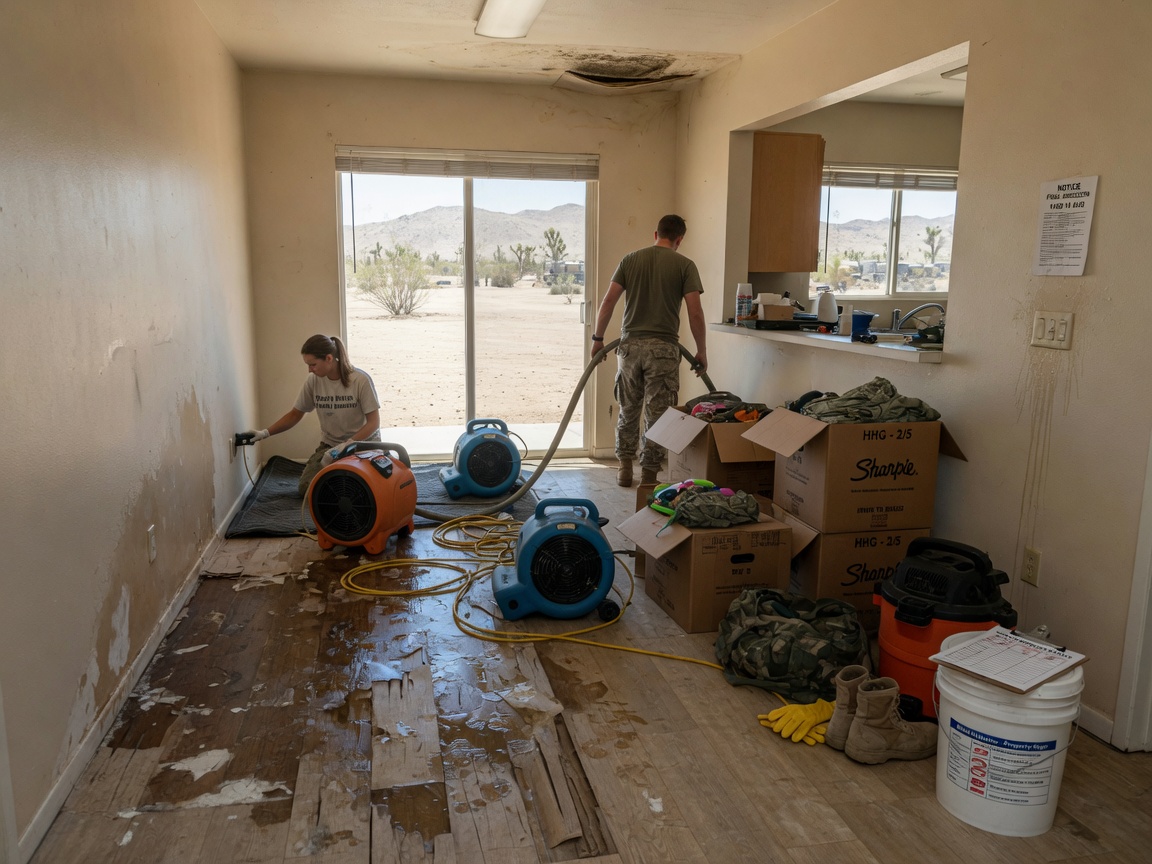
We handle 24/7 emergency water extraction, burst pipe cleanup, sewage backup cleanup, structural drying and full water damage restoration across Palmdale and the Antelope Valley.
Around Palmdale
We regularly work near:
- 📍Palmdale Regional Airport
- 📍Pelona Vista Park
- 📍Antelope Valley Mall
- 📍Palmdale Regional Medical Center
- 📍Dry Town Water Park
Emergency Water Removal in Palmdale — Local Notes
- •Palmdale's winter lows below freezing are routine from late November into February, and open-valley wind strips heat from exposed plumbing faster than air temperature alone indicates.
- •Frozen pipes split during the cold but stay sealed by ice — flooding typically starts at thaw, often mid-morning once the house is empty.
- •Disconnecting garden hoses before the first freeze prevents a large share of the hose bib failures seen here each winter.
- •Aerospace-era housing around Downtown and East Palmdale commonly retains galvanized supply lines and cast iron drains, both of which fail without warning.
- •Anaverde, Rancho Vista and other west-side slab tracts often used polybutylene supply piping, which fails at the fittings and hides under-slab leaks for weeks.
- •The flat valley floor sheds heavy rain rather than absorbing it, pooling storm water against garage doors in lower-lying East Palmdale and toward Lake Los Angeles.
Nearby cities we serve