Water damage restoration is the whole arc of the job, not just the part where the water comes out. It runs from the emergency call through extraction, structural drying, dealing with what cannot be saved, and putting the building back. Our line is answered 24 hours a day, every day, and the first hours are the ones that determine how much of that arc you end up needing.
The timeline you are working against. In the first minutes, water spreads across flooring and soaks anything porous it touches. Within hours it is wicking up drywall at roughly an inch an hour, moving into subfloor, insulation and wall cavities, and travelling along joists into rooms that look untouched. Between 24 and 48 hours, mold begins establishing on damp organic material. Beyond that, hardwood cups, particleboard swells permanently and the job shifts from drying toward demolition and rebuild. Restoration is about catching the building as early on that curve as possible.
Finding all of it, not just the obvious part. The most common reason a restoration job fails is that someone dried what they could see. Water travels behind baseboards, under cabinet kickboards, up inside wall cavities and beneath flooring, and California's dry inland air makes this worse by drying surfaces quickly while the cavity behind stays saturated. Moisture meters and thermal imaging map the actual extent before drying is planned, and reference points are recorded so the same spots can be read each day.
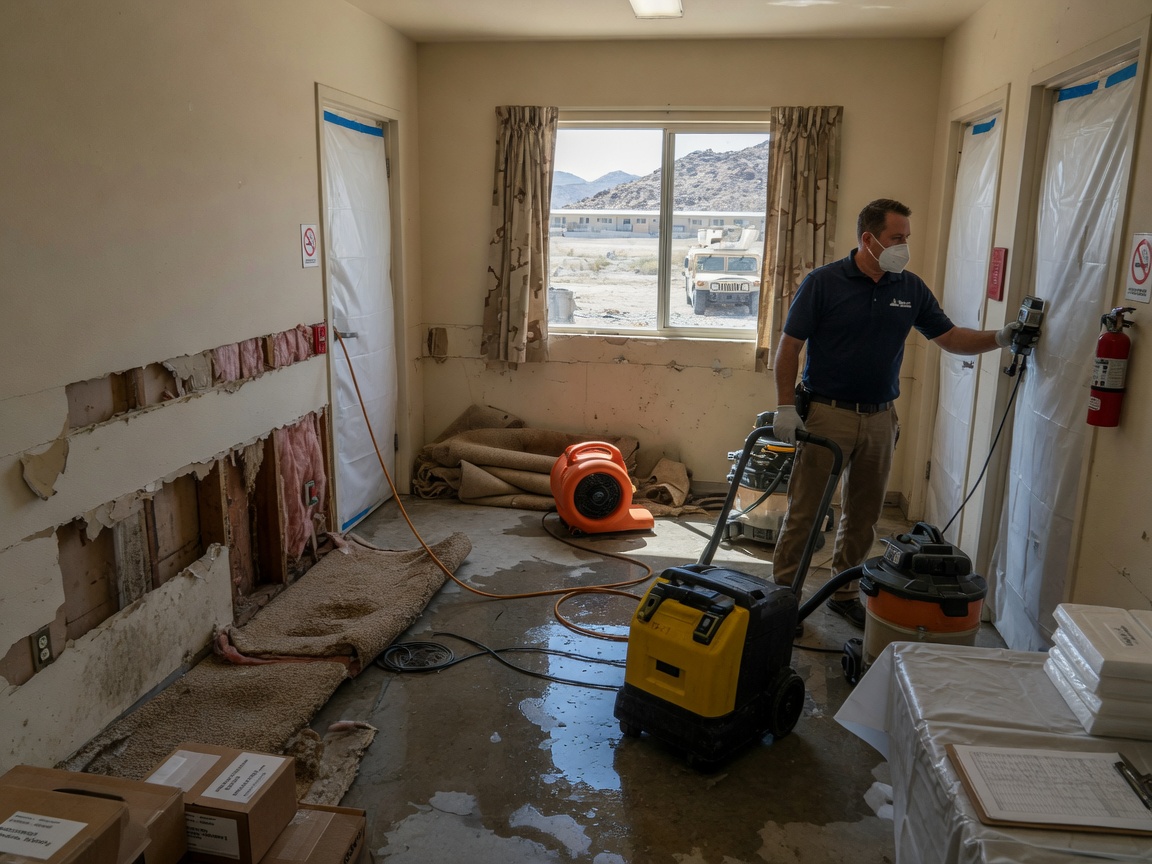
Drying the structure, not just the air. Air movers create the airflow that pulls moisture out of materials; commercial dehumidifiers remove it from the room so it does not simply redeposit. Where water is trapped under flooring or inside a wall cavity, the assembly has to be opened or specialist mat systems used, because sealed water does not dry no matter how long equipment runs. Readings are taken at the same points daily, and equipment stays until the structure reads dry rather than until a set number of days has passed. Most residential jobs run three to five days.
What gets saved and what does not. Framing, subfloor, hardwood caught early and most hard surfaces can usually be dried in place. Saturated insulation, carpet pad, particleboard cabinetry and drywall that took contaminated water generally come out. Anything touched by black water — sewage or water that crossed ground outside — is removed rather than dried if it is porous. We tell you which category each thing falls into before work starts rather than after.
Documentation for the claim. Moisture readings, photographs and daily drying logs are recorded throughout. This is the evidence adjusters ask for, and it is the difference between a claim that moves and a claim that stalls.
Technician insight
The jobs that go wrong are almost always the ones where someone dried what they could see and stopped. Inland California air is dry enough that a wall will feel completely fine to the hand while the cavity behind it is still soaked — and that is the moisture that turns into a mold call six weeks later. Trust the meter, not your hand, and keep reading the same points every day.
Ceiling Leak From an Upstairs Bathroom
A failed toilet supply line on an upper floor ran for several hours before anyone noticed water staining the ceiling below. Thermal imaging showed the water had travelled along the joists well past the visible stain and into an adjoining wall cavity. The saturated ceiling section and insulation were removed, the cavity opened so the framing could dry, and readings taken daily for five days. The framing and subfloor were dried and saved; the ceiling and insulation were replaced.
Water Damage Restoration Services We Offer
✓Emergency Water Extraction
Standing water pulled out on the first visit with truck-mounted and portable units, day or night.
✓Structural Drying and Dehumidification
Air movers and commercial dehumidifiers sized to the space, with daily readings until the structure genuinely reads dry.
✓Moisture Mapping and Assessment
Meters and thermal imaging to trace water behind baseboards, under cabinets and inside wall cavities before drying is planned.
✓Mold Prevention and Remediation
Antimicrobial treatment and containment where water sat long enough for growth to begin, with removal of materials that cannot be treated.
✓Flooring and Drywall Restoration
Drying hardwood and hard surfaces in place where possible, and removing and replacing carpet pad, saturated drywall and swollen cabinetry where it is not.
✓Contents Handling
Moving, drying and documenting affected belongings, and identifying what has to be listed as a loss on the claim.
How it works
- 1
1. Emergency Call and Dispatch
We take the call at any hour, walk you through shutting off the water and staying safe, and dispatch a crew to your address.
- 2
2. Inspection and Water Classification
The source is traced, the water is classified as clean, grey or black, and the full extent is mapped with meters and thermal imaging before anything is decided.
- 3
3. Extraction
Standing water is removed and carpet lifted where needed so water is not left trapped against pad and subfloor.
- 4
4. Removal of Unsalvageable Materials
Saturated insulation, carpet pad and anything contaminated is taken out, and wall cavities are opened where water is sealed inside and cannot otherwise dry.
- 5
5. Structural Drying and Daily Monitoring
Equipment is positioned and readings taken at fixed points each day. The drying plan adjusts to what the numbers show rather than following a fixed schedule.
- 6
6. Final Readings, Repair and Walk-Through
Once readings confirm the structure is dry, materials are repaired or replaced and we walk the space with you, hand over the final numbers and the documentation for your claim.
Pricing
Cost is driven by the volume of water, how far it spread, which materials got wet, whether the water was clean or contaminated, and how many days of drying the building needs. Hardwood, plaster and multi-layer subfloor take longer and cost more than tile over slab, and a contaminated water job costs more than a clean one because more material has to come out. You get a full scope and quote after the on-site assessment and before any work begins.