
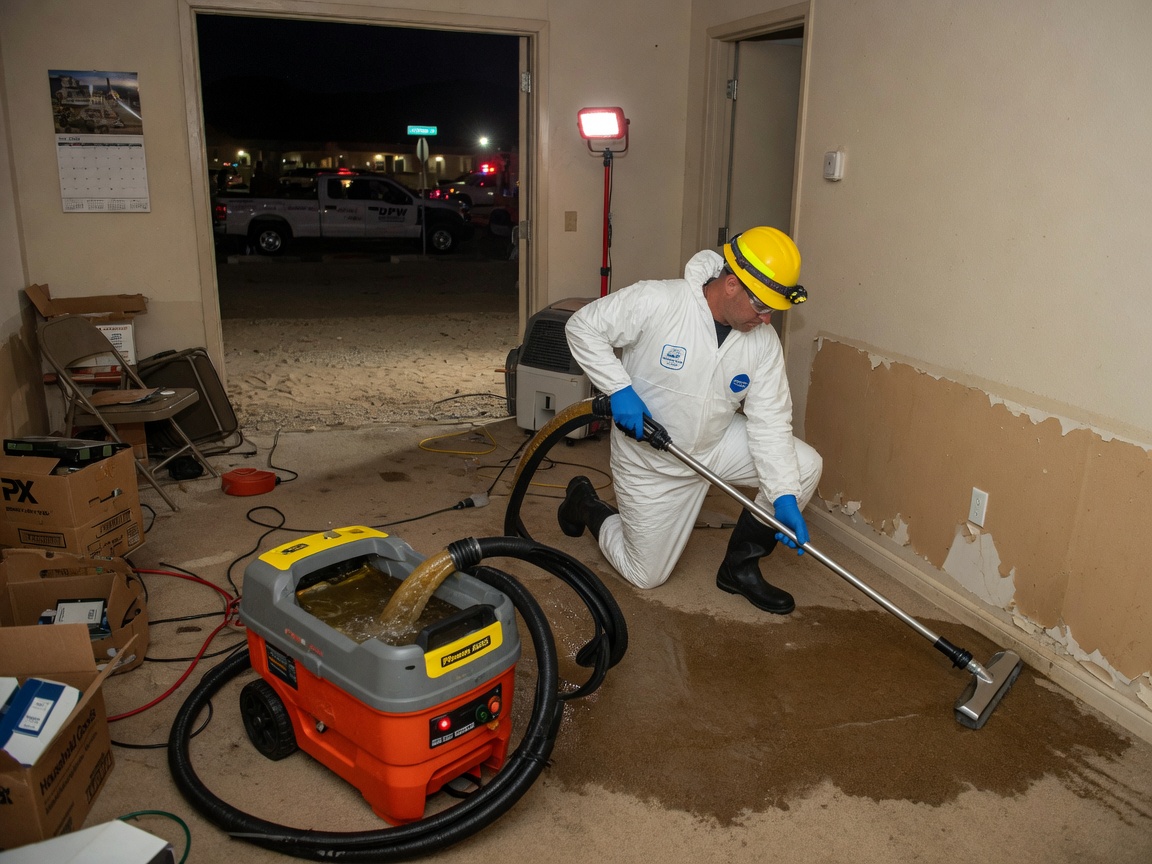
Water extraction is the part of the job that has to happen first and has to happen fast. Everything else — drying, repairs, whether your flooring survives — depends on how quickly the standing water comes out. Our line is answered 24 hours a day, every day, because the gap between a call at midnight and a call at 8am is routinely the difference between drying a floor and replacing it.
Why the clock matters this much. Water wicks up drywall at roughly an inch an hour, travelling well past where it started. Within minutes it has spread across flooring and soaked into anything porous. Within an hour or two it is into the subfloor, the insulation and the wall cavities. Within 24 to 48 hours mold begins establishing on damp organic materials — drywall paper, wood, carpet backing. Hardwood cups and crowns. Particleboard cabinetry swells and does not come back. Every one of those thresholds is a step up in cost, and they are all governed by how long the water sat.
What actually happens on site. The crew traces the source and stops it if it is still running, then isolates power to affected areas before anyone steps into standing water. Water is pulled out with truck-mounted units for volume work and portable extractors for rooms they cannot reach with a hose. Carpet is usually lifted so water underneath is not left trapped against the pad and subfloor. Then moisture meters and thermal imaging map how far the water actually travelled, which is nearly always further than it looks — behind baseboards, under cabinet kickboards, up inside wall cavities and along joists into rooms that never got wet on the surface.
Clean, grey and black water. Not all water is handled the same way. Clean supply water from a burst pipe or a supply line can usually be extracted and the materials dried in place. Grey water from appliances carries some contamination and needs more care. Black water — sewage, or anything that has crossed ground outside — carries bacteria, so porous materials that absorbed it generally have to be removed rather than dried, and the area is cleaned and treated before drying begins. Getting that classification right at the start determines what can be saved.
California's range of conditions. Very dry desert air pulls surface moisture off quickly, which is deceptive: a wall can feel bone dry while the cavity behind it is still saturated. Humid coastal conditions slow drying and raise mold risk. That is why the drying plan is built on site from actual meter readings rather than a standard setup, and why equipment stays until the numbers say the structure is dry rather than until a set number of days has passed.
Technician insight
The mistake that costs people the most money is waiting until morning. Water does not pause overnight — it keeps wicking up drywall and spreading through the subfloor for every one of those hours. We would far rather take the call at 2am and find it is smaller than you feared than arrive at 9am to a job that was straightforward six hours earlier.
Supply Line Failure Found in the Morning
A braided supply line under a bathroom sink let go shortly after midnight and ran until the household woke. Water had crossed the hallway and wicked around fourteen inches up the drywall in two rooms, with the subfloor saturated beneath. Extraction cleared the standing water, the lower section of drywall was opened so the cavity could dry, and readings were taken daily for four days until the structure read dry. The hardwood in the hallway was dried in place and saved.
24-7 Emergency Water Extraction Services We Offer
✓Burst Pipe Water Extraction
Immediate removal of standing water after a supply line or pipe failure, including water that has travelled into adjoining rooms and wall cavities.
✓Appliance Failure Extraction
Water heaters, washing machine hoses, dishwashers and refrigerator supply lines — failures that often run for hours before anyone notices.
✓Storm and Flood Water Removal
Extraction of water that entered from outside under doors and thresholds, handled as contaminated water with appropriate cleaning and material removal.
✓Crawl Space and Sub-Floor Extraction
Pumping out water that has collected beneath the structure, where it will otherwise keep feeding moisture up into the floor system.
✓Bathroom and Toilet Overflow Extraction
Fast extraction after overflows, with classification of the water to determine what can be dried and what needs removing.
✓Commercial Water Extraction
Offices, retail units and multi-unit buildings, with containment so the rest of the premises can keep operating during drying.
How it works
- 1
1. Call and Immediate Guidance
We walk you through shutting off the water at the main, cutting power safely to affected rooms, and what to move or photograph before anyone arrives. Then a crew is dispatched.
- 2
2. Source Control and Safety
On arrival the crew confirms the source is stopped and isolates electrical hazards before entering standing water. Nobody walks into water near live outlets or panels.
- 3
3. Water Classification
The water is identified as clean, grey or black. This determines what can be dried in place and what has to be removed, and it is the decision that most affects the final cost.
- 4
4. Extraction
Truck-mounted units and portable extractors pull the standing water. Carpet is lifted where needed so water is not left trapped against pad and subfloor.
- 5
5. Moisture Mapping
Meters and thermal imaging trace how far water actually travelled — behind baseboards, under cabinets, inside wall cavities and along joists. Reference points are recorded for daily monitoring.
- 6
6. Drying Equipment and Monitoring
Air movers and commercial dehumidifiers are positioned and left running, with readings taken at the same points each day until the structure reads dry.
Pricing
Cost is driven by how much water there is, how far it spread, which materials got wet, whether the water was clean or contaminated, and how many days of drying equipment the building needs. Hardwood, plaster and multi-layer subfloor take longer and cost more than tile over slab. You get a quote after the on-site assessment and before any work begins, so you are deciding with a real number rather than an estimate over the phone.