
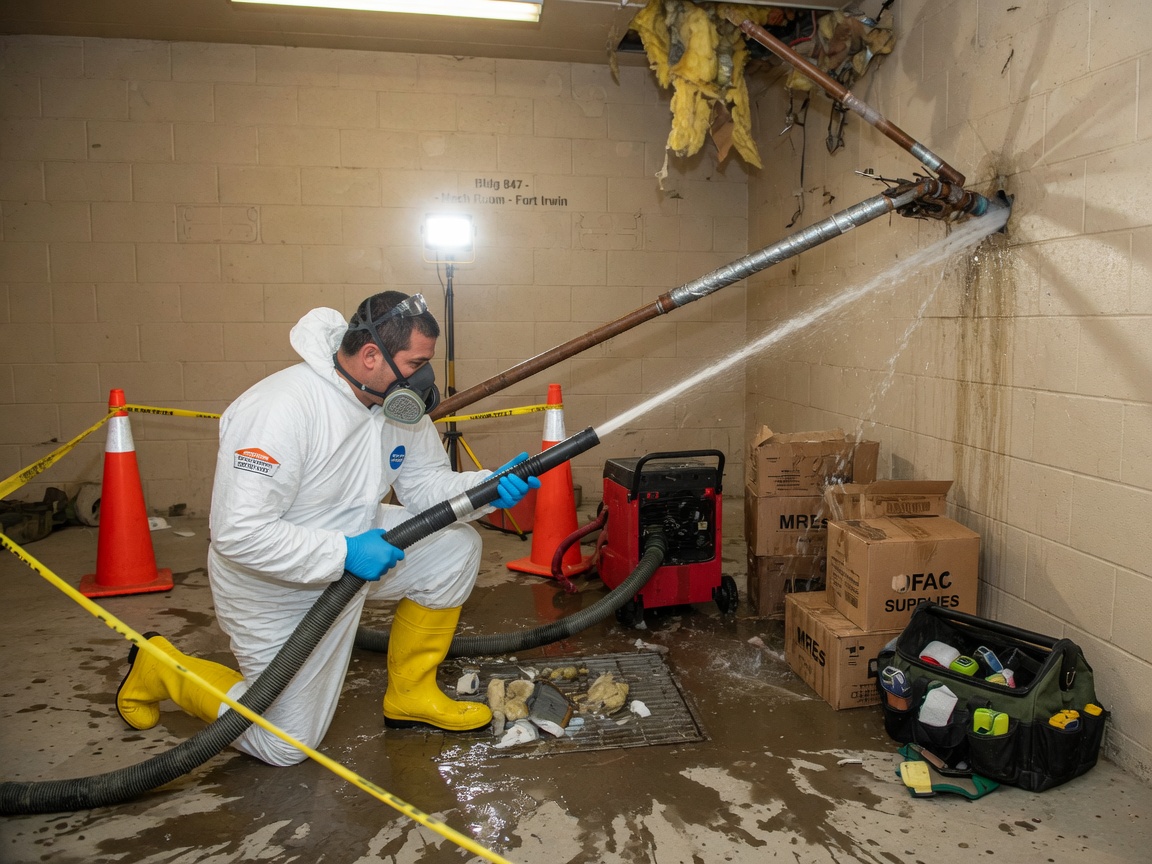
If a pipe has just burst, stop reading and shut the water off at the main. It is usually where the supply enters the house, often near the front hose bib, in a garage, or at a meter box near the street. Turn it clockwise until it stops. Then open a downstairs faucet to drain what is left in the lines. That one action does more to limit the damage than anything else that happens today. Once it is off, call us — the line is answered 24 hours a day.
Why burst pipes cause so much damage so fast. A failed supply line under pressure puts out a genuinely large volume of water, and unlike a leak it does not stop until someone shuts the valve. Most bursts happen overnight or while a house is empty, which is why the water has usually been running for hours by the time it is found. In that time it has spread across flooring, wicked up drywall at roughly an inch an hour, soaked insulation and subfloor, and travelled along joists into rooms that appear untouched.
Frozen pipes behave differently, and it catches people out. Water expanding as it freezes splits the pipe, but the ice plug seals the split while it is still frozen. Nothing leaks. The flooding starts at thaw, often hours later and frequently mid-morning once everyone has left. If you have had a hard freeze and suspect a pipe froze, shut the main off before things warm up rather than waiting to see what happens. Never thaw a pipe with an open flame.
Why pipes fail in California homes. Galvanized supply lines in pre-1970s housing corrode from the inside until a joint gives way with no warning drip first. Polybutylene piping, common in 1980s and 90s construction, fails at the fittings decades on. Winter freezes split exposed runs in garages, crawl spaces and uninsulated exterior walls, which is routine in the High Desert and Antelope Valley where overnight lows drop well below freezing. Braided washing machine hoses and water heater connections fail from age. And in slab-on-grade housing, a supply line under the concrete can run for weeks before anyone notices a warm patch on the floor or an unexplained water bill.
What we do on arrival. The source is confirmed stopped and electrical hazards isolated before anyone enters standing water. Water is extracted, carpet lifted where needed so nothing stays trapped against the pad, and the actual extent mapped with moisture meters and thermal imaging. Where water is sealed inside a wall cavity or under flooring it cannot dry on its own, so those assemblies are opened — but only the sections the meters show are wet, not whole rooms. Air movers and dehumidifiers then run with daily readings at fixed points until the structure reads dry, typically three to five days.
Technician insight
The single most useful thing any homeowner can do is know where their main shutoff valve is and check that it actually turns — before they need it. Valves that have not been moved in fifteen years seize. People lose whole floors standing in water trying to find a valve in the dark, and a burst line puts out a remarkable amount of water in the twenty minutes that search takes.
Frozen Line That Flooded at Thaw
An uninsulated supply line in a garage split during a hard overnight freeze but stayed sealed by ice. It began flowing mid-morning once temperatures rose, with the house empty, and ran for roughly four hours. Water had crossed into an adjoining bedroom and wicked around sixteen inches up the drywall. The lower drywall and saturated insulation were removed so the cavity could dry, readings were taken daily for four days, and the framing and subfloor were dried in place and saved.
Burst Pipe Emergency Cleanup Services We Offer
✓Frozen and Burst Pipe Response
Emergency extraction after a freeze failure, including the common case where the split flooded at thaw hours after the cold snap.
✓Supply Line and Appliance Hose Failures
Washing machine hoses, water heater connections, toilet and sink supply lines — failures that typically run for hours before discovery.
✓Slab Leak Water Cleanup
Extraction and drying where a supply line beneath the concrete has been running undetected, including drying the slab itself.
✓Hidden Leak Detection
Thermal imaging and moisture meters to locate a split inside a wall or under flooring before anything is opened up.
✓Targeted Drywall and Insulation Removal
Opening only the sections meters show are wet, so repairs stay limited rather than gutting whole rooms.
✓Structural Drying and Mold Prevention
Air movers and dehumidifiers with daily monitoring, plus antimicrobial treatment where water sat long enough for growth to begin.
How it works
- 1
1. Shut Off and Call
Shut the water off at the main and open a low faucet to drain the lines. Call us at any hour — we will confirm you have the right valve and talk through electrical safety while a crew is dispatched.
- 2
2. Safety and Source Confirmation
On arrival the crew confirms the supply is isolated and cuts power to affected areas before entering standing water. Nobody steps into water near live outlets or a panel.
- 3
3. Extraction
Standing water is pulled out with truck-mounted and portable units, and carpet is lifted where needed so water is not left trapped against pad and subfloor.
- 4
4. Moisture Mapping
Meters and thermal imaging trace how far the water actually travelled — behind baseboards, under cabinets, inside wall cavities and along joists. Reference points are recorded for daily monitoring.
- 5
5. Targeted Opening and Material Removal
Only the sections that read wet are opened. Saturated insulation and carpet pad come out, since neither dries reliably in place.
- 6
6. Drying, Final Readings and Repair
Equipment runs with daily readings until the structure reads dry, then materials are repaired or replaced and you get the final numbers and your claim documentation.
Pricing
Cost depends on how long the pipe ran before it was shut off, how far the water spread, which materials got wet, and how many days of drying the building needs. A burst caught within the hour is a very different job from one that ran overnight. You get a full scope and quote after the on-site assessment and before any work begins.