
2026-09-03 · Carlos Mendoza
Water Damage Insurance Claims 101: What High Desert Homeowners Need to Know Before You Call Your Adjuster
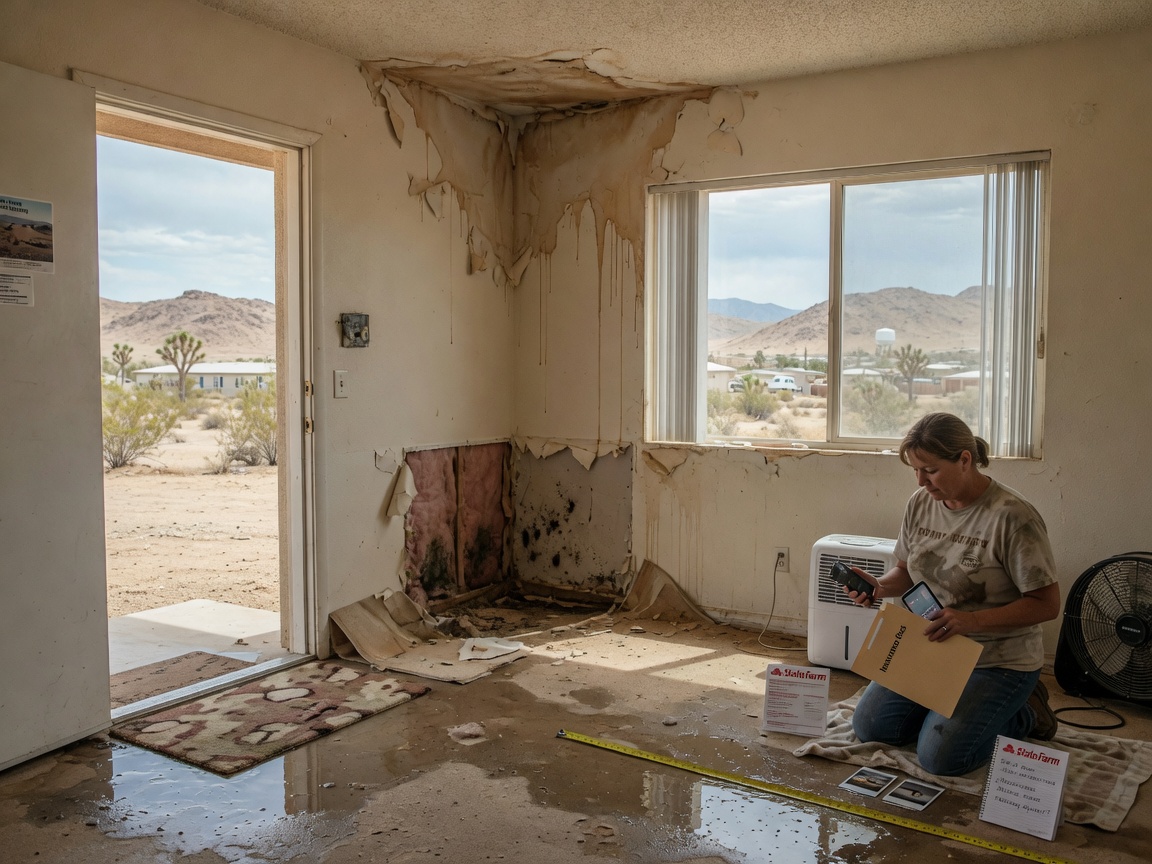
Water damage is one of the most commonly claimed and most commonly disputed categories in home insurance. The disputes almost always come down to the same two questions: was this sudden and accidental, or gradual? And can you prove what happened and when?
Everything below is general information, not advice about your specific policy. Coverage varies enormously between carriers and between policies from the same carrier. Your declarations page and policy wording are what actually govern your claim — read them, and ask your carrier directly when something is unclear.
The Distinction That Decides Most Claims
Standard homeowner policies in California are generally built to cover damage that is sudden and accidental. A supply line that lets go. A water heater that fails. A washing machine hose that splits. A pipe that bursts in a freeze.
What they generally do not cover is damage that accumulated over time: a slow drip under a sink that rotted the cabinet base over two years, a roof that has been leaking since last winter, seepage through a foundation, or anything a carrier can characterise as a maintenance failure.
This is why the timeline matters so much, and why a slab leak that ran for six weeks before you noticed the warm patch on the floor is a harder claim than a pipe that burst last night. It is also why documenting when you discovered it is worth real money.
Three Things That Usually Need Separate Coverage
Flood. Water that arrives from outside — storm runoff coming in under a garage door, a wash overflowing, surface water — is normally excluded from standard homeowner policies entirely. It requires separate flood insurance, commonly through the NFIP or a private flood policy. NFIP policies typically carry a 30-day waiting period before coverage starts, so buying it when rain is forecast does not help. If you are in a low-lying spot or near a wash anywhere in the High Desert or Antelope Valley, this is worth checking before you need it.
Sewer and drain backup. Many standard policies exclude backup through sewers and drains unless you have added a specific endorsement, which is usually inexpensive and sold as a rider. If you are on septic, check how your policy treats septic failures too. Plenty of people discover they do not have this after the backup. See our page on sewage backup cleanup for what that work involves.
The failed part itself. Many policies pay to repair the damage the water caused but not to replace the thing that failed. Your ruined flooring may be covered while the burst pipe or dead water heater is not. Ask specifically about this, because people are routinely surprised by it.
Your Duty to Mitigate — Do Not Wait for Permission
This is the single most important practical point, and it trips people up constantly.
Nearly every policy places a duty on you to take reasonable steps to prevent further damage after a loss. That means shutting the water off, getting standing water extracted, and starting drying promptly. If you leave a flooded room sitting for four days waiting for an adjuster to visit, a carrier can argue that the mold and the spread that followed were avoidable, and reduce what they pay accordingly.
So: do not wait for adjuster approval before calling for emergency mitigation. Document everything thoroughly first, then get the water out. Carriers expect this. Emergency mitigation and the claim run in parallel, not in sequence. Our line is answered 24 hours a day for exactly that reason — see 24/7 emergency water extraction.
Keep every receipt for anything you spend on mitigation, including a fan you bought, a hotel night, or a plumber's emergency call-out.
Documentation That Actually Helps
Before you move anything:
- Wide shots of every affected room from several angles
- Close-ups of the damage: standing water, wet flooring, stained ceiling, the failed component if visible
- A shot showing how high the water reached on the wall
- Contents that got wet, including model and serial numbers on appliances and electronics
- Video walking through the property narrating what you are seeing
Then write down the times: when you discovered it, when you shut the water off, when you called for mitigation. "Discovered 1:40am, main closed 1:52am, extraction crew on site 3:15am" is worth far more than a vague account.
Keep the damaged materials. Do not take soaked carpet to the tip before anyone has seen it. Photograph it, bag it, put it in the garage.
Ongoing, the most useful evidence is what a restoration crew produces as they work: moisture readings at fixed points, daily drying logs and photographs. That is the record adjusters are used to seeing, and it is frequently what moves a stalled claim.
Talking to the Adjuster
Be accurate and be complete, but be careful about speculating. If you do not know how long something has been leaking, say you do not know rather than guessing at a number that later gets used to characterise the loss as gradual.
Walk them through everything, including places the water travelled that are not obvious — behind baseboards, under cabinet kickboards, inside wall cavities, along joists into adjoining rooms. Moisture readings are useful here precisely because they show damage that is invisible.
Keep a written note of who you spoke to, when, and what was said.
Replacement Cost vs Actual Cash Value
Worth knowing which you have, because it substantially changes your payout. Replacement cost pays what it costs to replace the item now. Actual cash value pays that figure minus depreciation, which on ten-year-old carpet or a fifteen-year-old water heater can be most of the value.
Many policies pay ACV initially and release the remaining "recoverable depreciation" once you have actually done the work and submitted receipts. If yours works that way, do not leave that money on the table by not filing the final paperwork.
If You Are Offered Less Than the Work Costs
Ask for a line-item breakdown rather than a lump sum, so you can see what was included and what was missed. Very often the gap is something specific that was overlooked — drying equipment days, a room the water reached that was not inspected, or contents listed generically.
Supplemental claims are normal in this industry. If damage turns up during the work that was not visible at the initial inspection, which happens regularly once flooring comes up, that gets submitted as a supplement with its own documentation.
If you and the carrier remain far apart, most policies contain an appraisal clause as a dispute mechanism, and public adjusters work for the policyholder rather than the insurer, usually for a percentage. Both are worth understanding before you need them.
One caution: be careful about signing an assignment of benefits handing your claim rights to a contractor. Read anything you are asked to sign while you are stressed and standing in a wet house, and do not sign it that night if you are unsure.
Local Realities Worth Knowing
In the High Desert and Antelope Valley, the two most common claim types are freeze-related pipe bursts in winter, which are usually covered as sudden and accidental, and storm runoff entering the property, which usually is not covered without flood insurance. Those two sit on opposite sides of the coverage line despite both being weather-driven, which surprises people every year.
Carriers have also been known to deny freeze claims on properties that were left vacant and unheated. If you own a rental, a second home or a short-term let that sits empty through winter, either keep the heat on at a low setting or shut the water off at the main and drain the system. Our guide to winterizing a High Desert home covers this.
For flash flood specifics, see water damage after Mojave Desert flash floods.
The Short Version
- Document everything thoroughly before you move it, with times.
- Do not wait for the adjuster to start mitigation — you have a duty to limit further damage.
- Call your carrier's claim line promptly; most run 24 hours.
- Keep damaged materials and every receipt.
- Check whether you have sewer backup and flood endorsements before you need them.
- Ask whether you have replacement cost or actual cash value.
If you are dealing with water right now, call us at any hour. We will get the extraction moving and produce the readings, photographs and drying logs your adjuster is going to ask for.